
兵临城下
跳台之争,陈芋汐赢了0.3分_我的网站

A |
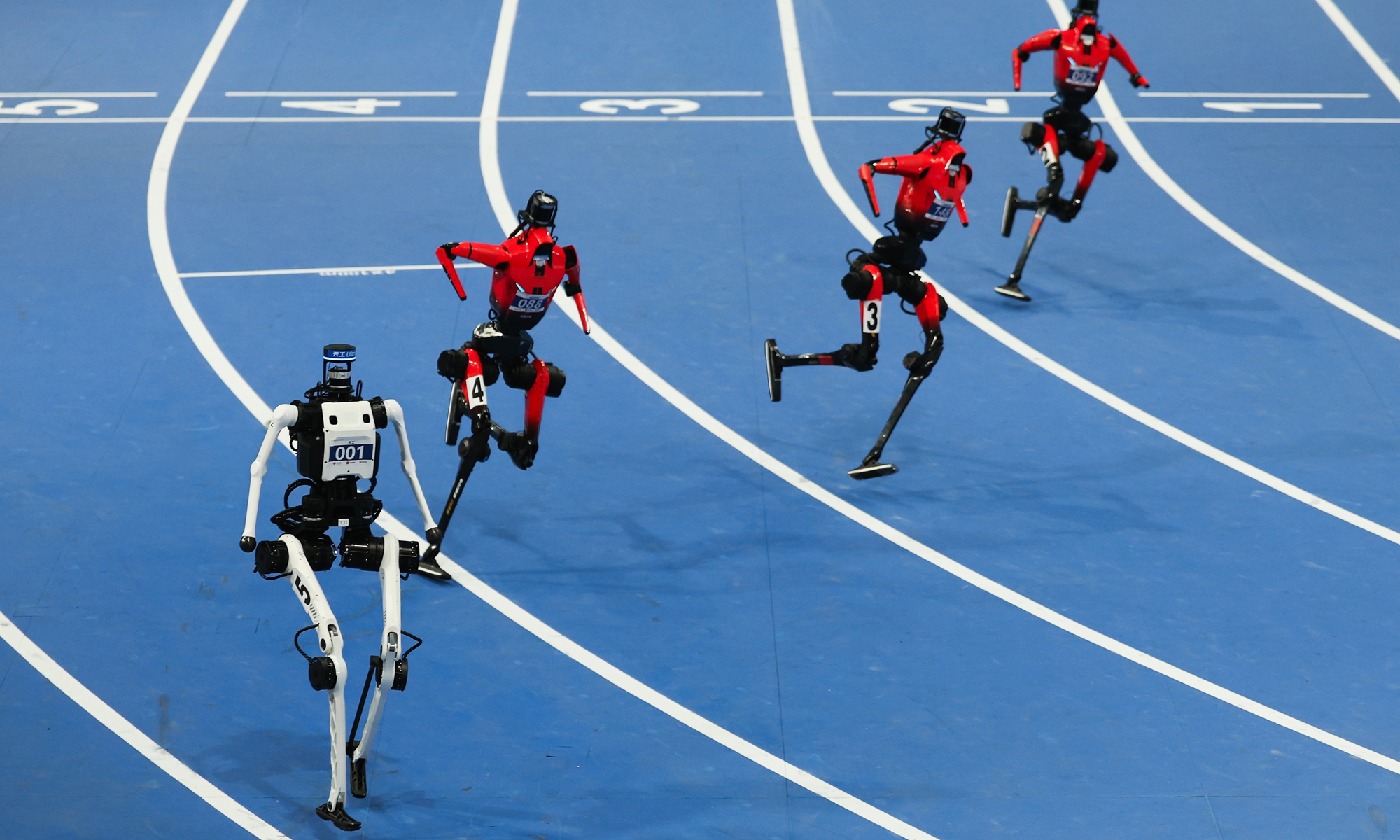
On the blue track inside the National Speed Skating Oval, robots chased each other in the 400-meter race. A sprinting Tien Kung robot was tripped by a rival robot lying on the track but did not fall. Instead, it adjusted its posture in seconds and continued toward the finish line with a result of 38.15 seconds, breaking human 400-meter race world record of 43.03 seconds, held by South African athlete Wayde van Niekerk.
This scene unfolded on Sunday, the first official competition day of the 2nd World Humanoid Robot Games (WHRG). Later that evening, a humanoid robot named Lightning, developed by Honor Co., broke the long-standing human 1,500-meter world record of 3:26 set by Moroccan athlete Hicham El Guerrouj with a time of 2:30.22. Just one night earlier, during the opening ceremony's 100-meter sprint and high jump demonstrations, humanoid robots had already shattered records long held by human athletes Usain Bolt and Javier Sotomayor — merely an appetizer for the five-day sci-fi spectacle.
The Games have attracted 666 teams from 16 countries across six continents, up 138 percent from its inaugural edition. The number of participating robots quadrupled to 2,056, the Global Times learned from the organizing committee.
Yet the biggest change this year was not only the scale, but also the technological maturity. More teams have shifted from remote-controlled robots to fully autonomous systems. Chinese observers, after watching several events, said humanoid robots are no longer limited to simple demonstrations of walking or dancing. Increasingly, they are being tested in environments that demand speed, coordination, perception and decision-making.
From movement to intelligence
Behind the record-breaking performances are a series of technological upgrades. During the running events, Global Times reporters observed that robots were able to make subtle movements around their hip joints while walking, allowing them to maintain balance and produce movements closer to human biomechanics.
Guo Yijie, technical director of Tien Kung Ultra, said the improvement came from advances in hardware design.
"Robot joints have improved in torque and speed. As competitions demand higher power output, the reliability of the main control board, power board and high-power battery discharge capability have become increasingly important," Guo told the Global Times.
According to Guo, the same Tien Kung Ultra robot was used in both sprinting and jumping events. For running, the waist needs rotation to balance the inertia generated by leg movements. For jumping, the upper body requires pitching movement to help the robot achieve greater distance or height, Guo said, noting that these can all be achieved with only slight adjustments to the waist configuration were needed, and it highly demonstrated to the robot design's flexibility.
Besides the hardware upgrades, developments in robots' faster decision-making in "brains' is better showcased in football competitions.
The Booster T2 robot used by many domestic and overseas football teams has increased its onboard computing capability by 10 times compared with the previous generation. The time from recognizing the goal to deciding whether to pass or shoot has been reduced to around 100 milliseconds - faster than the time humans usually need to blink.
Cheng Hao, a technical representative from Boosters Robotics, said the improvement represents an "end-to-end" transformation in embodied intelligence.
"In the past, robots relied on separate steps: perception, planning, decision-making and execution. Each stage was disconnected. Now, with an end-to-end motion foundation model, visual input can directly generate joint control commands," Cheng said.
The newly introduced table tennis and tennis competitions are also testing another important capability: perception.
"Robots are moving from simply recognizing the three-dimensional position of a ball to understanding the movement information of opponents and more complex environments," said Li Yinghui, a postdoc researcher and the leader from the Hong Kong University team at the table tennis event. Such capabilities developed in sports scenarios could eventually be transferred to other scenarios in industries or daily life, Li said.
Beyond entertainment
Though clips from the robot competitions have made a buzz on social media, with some critics from Western media questioning why robots need to dance, play football or compete in athletics while arguing that these activities appear far from everyday needs.
Zhou Changjiu, Vice President of the RoboCup Federation and the Robotics Competition Association of the Asia-Pacific (RCAP), stressed robot sports are not designed for entertainment alone. "Robot competitions are testing the capabilities needed for humanoid robots to enter the real world," Zhou told the Global Times.
Different events evaluate different abilities. Sprinting tests speed, marathons examine battery endurance and energy management, while football provides a comprehensive test because of its dynamic and unpredictable nature, testing intelligence, manipulation, interaction, safety, cost and trust at the same time, Zhou said.
Unlike a single-task demonstration, football requires robots to cooperate. Players must understand their own roles, recognize teammates and opponents, and make collective decisions - a form of swarm intelligence that could become essential when robots work together in homes, factories and emergency rescue environments.
Entertainment, however, can generate business opportunities. Gu Jinghai, brand director of EYOU Robot Co, told the Global Times that the company sold 95,000 integrated joints in China in 2025 and expects sales to exceed 1 million units in 2026. Growth mainly comes from planetary joints used in entertainment robots, while harmonic joints for industrial robots are also expanding steadily, he said.
Jiao Jichao, an executive from UBTECH Robotics, said the criticism that "Chinese robots can only sing and dance" reflects only a temporary stage of development. "Performance and dancing are also real commercial demands, and their existence has value," Jiao said. "Beyond entertainment, Chinese robots are already demonstrating intelligent capabilities that support practical applications in manufacturing, and partnerships with companies including Huawei and Foxconn, where robots have already entered production lines in small-scale applications."
The Outline of the 15th Five-Year Plan for National Economic and Social Development of China stated that the country will construct a comprehensive cultivation system for future industries including the embody intelligence as new economic growth drivers.
Zhou said the development of humanoid robots is not only about individual machines, but about building an entire ecosystem.
China's advantage lies in its complete supply chain, abundant application scenarios and manufacturing capabilities, while the fast growing industry still faces challenges such as the lack of unified standards.
Gu said the company has launched mass production of robotics joint under domestic standard of auto parts.
Robot competitions can help address these issues by creating common standards in areas such as competition rules, robot dimensions, communication systems, batteries and joint modules. "As applications expand, the cost of key robot components will continue to decline," Zhou said.
"Numbers are magic," Zhou said. "If producing one robot costs a huge amount because it is handmade, producing one million robots will completely change the cost structure."
For humanoid robots, the race taking place inside the Ice Ribbon may not ultimately be about who crosses the finish line first. It may be about whether these machines can learn to navigate the far more complicated race outside the stadium - the race into the real world.
。

B | 全红婵以一枚银牌开启自己的世锦赛首秀,接下来,这位15岁的东京奥运会冠军将与陈芋汐在30日出战女子双人10米台项目,有望以一枚金牌结束自己的首次世锦赛之旅。

C | 陈芋汐卫冕成功陈芋汐险胜全红婵折桂,这是两名中国选手继东京奥运会后再度上演“神仙打架”。国际泳联官网赛后评论称,陈芋汐和全红婵在布达佩斯交换了东京奥运会时领奖台的位置,其他选手被她们远远甩在身后——奥运会四朝元老、马来西亚选手潘德莉拉·帕姆获得铜牌,她的成绩比陈芋汐少了78.4分。从预赛和决赛,陈芋汐与全红婵之间的较量十分激烈:预赛中,陈芋汐、全红婵分别以总分413.95分、410.85分的成绩位列第一和第二;半决赛中,陈芋汐总分继续保持领先。决赛前两跳之后,全红婵领先,不过她在第三跳207C(向后翻腾三周半抱膝,难度系数3.3)动作上出现失误,陈芋汐反超至第一。

D | 最后两跳,陈芋汐动作也出现瑕疵,最终以417.25分夺冠。“一套动作下来有些瑕疵,特别最后两跳有些失误。”陈芋汐赛后如此评价自己的表现。陈芋汐在2019年就夺得世锦赛该项目冠军,此番登顶意味着她卫冕成功。在她看来,两次世锦赛冠军感受完全不同,“上次夺冠时对世锦赛还没有太多概念,经过大赛历练后,更加理解这样的金牌对我来说的意义”。全红婵输在207C作为东京奥运会女子单人10米台冠军,全红婵当时在35次打分中得到24个满分10分。不过,207C这个动作一直是全红婵比赛中的软肋:东京奥运会女子10米台预赛,该动作仅得到47.85分,半决赛为70.95分;去年全运会女团跳水项目预赛,该动作拿到59.6分。此次世锦赛,她的这个动作从预赛到决赛得分都不高:预赛64.35分,半决赛62.7分,决赛61.05分。决赛后全红婵说,“比赛中有那么一瞬间想得有点多,第三跳以后就没有分散注意力了。我觉得自己状态很好,就是207C差一些,以后继续努力练吧。”两人明日搭档双人项目自1982年以来,中国跳水队已连续16次在游泳世锦赛女子10米台项目中夺得奖牌。28日的这场决赛,也是中国跳水队连续12次有两名女选手同时登上一个项目的世锦赛领奖台。如今,陈芋汐和全红婵成为中国跳水队在女子单人10米台这个项目上的“双保险”。东京奥运会延期后,经历发育苦恼的陈芋汐去年在奥运会不敌全红婵。不久后的全运会,全红婵再度夺冠。今年,陈芋汐的表现更全面、更稳定,两次队内测试赛和本届世锦赛均击败全红婵。新加坡《联合早报》认为,多种因素使全红婵的近期状态有些波动,“这一年,她长高10公分,也遭遇陈芋汐之前的发育难题。此外,与新教练还在磨合”。谈到接下来与全红婵搭档征战双人项目,陈芋汐说,两人是良性竞争,“有竞争才有前进动力。

E | 双人10米台,希望我俩把压力转换成动力,跳出正常水平就可以”。进入巴黎奥运周期,陈芋汐和全红婵之间的竞争还将继续。
Current article:http://2npqrom.piepengxikuozhuangzebaohouye.sbs/1iy/u7h88.html
Published on:00:53:56
相关新闻
- 华为首款新国标 3C 充电宝发售:100W 输出、12000mAh 容量、支持离线查找,399 元
- 大谷翔平が侍ジャパン辞退濃厚の松井裕樹に思い「悔しいと思いますけど…」 本人から連絡あったと明かす
- US Leads Missile Defense Drill to Tackle Pyongyang’s ‘Evolving Military Threats’ - Report
- 新手做拼多多如何运营
- 一个降低价格的好方法:索尼保持了微单次发货总量和数量的双冠。
- 浙江省博展出《韩熙载夜宴图》,观众将可凌晨逛博物馆,文物部门人员:需提前7天预约,限时逛6分钟
- 8月18日《洛奇英雄传》全新英雄 - 精灵弓箭手登场!
- 外国媒体表示,LGG8将于2019年在MWC发布,可能会有一个语音屏幕。
- 广西首艘CCS入级平陆运河示范船“北港运河001”建成试航,广西首艘CCS入级平陆运河示范船“北港运河001”建成试航
- 腾讯相关人士回应“IEG 重组 AI 游戏部门”:报道内容存在大量失实,所谓“成立新部门”系误读
最后更新
- 建设“橙汁之都” 重庆忠县力争到2030年柑橘全产业链综合产值突破200亿元,建设“橙汁之都” 重庆忠县力争到2030年柑橘全产业链综合产值突破200亿元
- 数据:在过去的25年里,美国的癌症死亡率下降了约27%。
- Officials say at least 189 bodies found at Colorado funeral home, up from about 115
- Chinese Embassy in Thailand issues reminder to nationals participating in cultural and sports activities in Thailand
- 家电数码换新如何用好国补?2026年8月手机电脑平板电视空调冰箱洗衣机国补申领最新实操指南,京东淘宝全套优惠口令整理,掌握叠加规则实现省钱采购
- vivo闯关下半场:AI未热、机海瓶颈、渠道拉扯
- Pan American Games to open in Chile with many athletes eyeing spots at Olympics
- Chinese bank to help Turkish enterprises tap into business opportunities at the Canton Fair
- 名记:多队紧盯东契奇 若和湖人闹僵便伺机出手
- Ali Fazal Has FOMO As Girls Will Be Girls Sweeps Major Categories at The Filmfare OTT Awards 2025